In This Guide
Does Water At The Bottom Mean The Tank Has Failed?
No. A water heater can look as though it is leaking from the bottom when water has run down from a connection, collected from a valve or formed through condensation. A confirmed leak in the storage tank itself requires replacement. Establish the actual source before treating every puddle as a failed tank.
This guide is for storage water heaters. A wall-mounted tankless unit has a different arrangement: use the tankless repair page and report the model and visible symptoms.
Reference: A. O. Smith’s guidance on possible water sources. These explanations prepare questions for assessment; they do not diagnose your installation remotely.
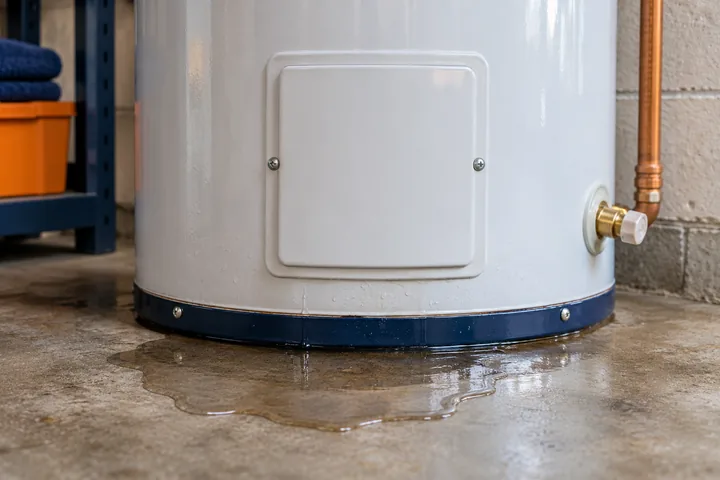
What Should You Do When You Find Water At The Base?
The first conversation should cover safety and water spread, then the possible source.
Keep The Approach Safe
Keep people away from wet electrical equipment and standing water. Do not cross a wet floor to reach a breaker, appliance control or shutoff.
Report Active Spread
Say whether water is dripping, pooling or reaching other rooms. Ask for guidance on safe isolation for the actual equipment and access conditions.
Leave Covers Closed
Report what is already visible safely. Do not remove electrical or burner covers, open a drain valve or run a test to reproduce the leak.
If water has submerged the equipment or its controls, do not restart it to see whether it still works. Arrange qualified assessment before use.
Urgent Water Heater Leak Requests → · CPSC: gas, CO and wet-appliance safety
What Can Make A Water Heater Look Like It Is Leaking From Below?
Use the visible pattern to describe the problem without choosing a replacement part yourself.
| What Is Visible | Possible Explanation | What Assessment Should Establish |
|---|---|---|
| A wet trail down the outside | Water from an upper fitting or nearby pipe. | Find the highest active leak point; distinguish it from water arriving from elsewhere. |
| Drips at the low drain outlet | A drain-valve or connection problem. | Identify whether water comes through the outlet or around the valve connection. |
| Water below a relief discharge pipe | Temperature-and-pressure relief valve discharge. | Assess the valve and the conditions causing discharge, including pressure or thermal expansion. |
| Droplets during a gas heating cycle | Combustion condensation or a separate leak. | Evaluate the actual model and operating conditions rather than assuming condensation is harmless. |
| Wetness near a closed electric access cover | An element or gasket leak is one possibility. | Have a qualified provider assess the unit; keep electrical covers closed. |
| Water persists after other sources are excluded | A leaking storage vessel is possible. | Confirm the tank-body leak before defining replacement work. |
| Water arrives from another direction | Nearby appliance, water line or ground seepage. | Check the surrounding source; a new heater would not correct an unrelated leak. |
References: A. O. Smith leakage checkpoints, gas-heater condensation and relief-valve discharge. Component arrangements vary by model.
Never cap or plug the relief outlet. Water from that pipe needs assessment, not a blocked escape path.
Explore Leak DetectionWhy Can A Leak Higher Up Leave Water At The Bottom?
The collecting point and the originating point may be different.
Where Was Water First Visible?
A useful description is specific: “There is a wet trail below the top connection” or “The floor is wet, but I cannot see where it starts.” Either is more helpful than guessing that the bottom seam has failed.
Only describe what you can see from a safe, dry position. Do not reach behind the cylinder, lift it or remove its jacket to trace hidden water.
What If There Is Water In The Drain Pan?
A pan shows collection, not the failed part. Mention whether the water is contained, overflowing or moving toward another surface. Ask the provider to identify the source and assess any affected materials separately.
If the source remains hidden, request a source assessment before choosing repair parts.
Manufacturer leakage checkpoints advise considering fittings, condensation, other appliances and surrounding water sources before concluding that the tank leaks.
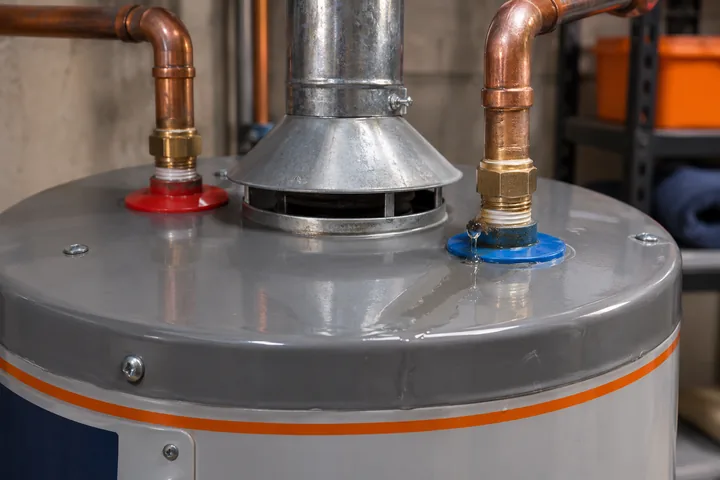
Does A Gas Or Electric Heater Change The Assessment?
Report the actual heater type instead of applying a diagnosis from a different model.
Gas Storage Heater
Cold incoming water can contribute to combustion condensation. Tell the provider whether moisture appeared around a heating cycle, without operating the heater to test it. That timing alone does not rule out a leak.
Electric Storage Heater
Element or gasket leakage belongs in the source assessment. Keep access covers closed; a wet cover or nearby puddle is a reason to report the condition, not open the compartment.
Model And Work History
Give the fuel type and safely available model information. Mention installation, flushing or valve work that happened shortly before the water appeared. Share the invoice rather than assuming the earlier work caused it.
The actual manual governs the equipment. References: gas combustion condensation and electric-heater leak checkpoints.
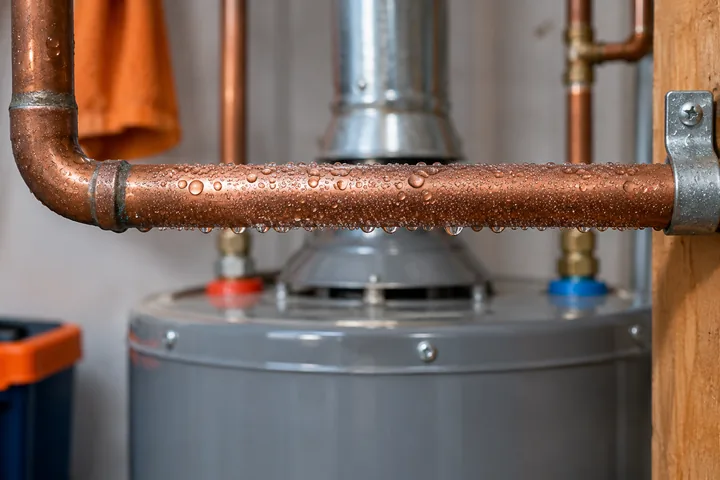
Can A Bottom Leak Be Repaired Or Does The Heater Need Replacing?
Separate a repairable component from a confirmed storage-tank failure.
A Repair May Be Appropriate
If a serviceable pipe connection, valve or component is the source, ask whether correcting that finding is suitable for the heater’s condition. Have the provider explain any related issue that also needs attention.
Replacement Is The Next Scope
A confirmed leaking storage vessel requires replacement. Ask how the failure was distinguished from connections and other sources. Flushing or external sealant is not a repair for a failed tank.
Resolve The Uncertainty
Ask which potential sources remain unchecked and what further assessment involves. A recommendation should state the finding, the remaining uncertainty and the proposed work clearly.
Age, condition, service history and applicable warranty can inform the decision. Ask for the reason for the recommendation for your unit, rather than treating an age estimate as proof of failure.
References: confirmed tank leaks and repair, replacement and warranty considerations.
What Should You Tell The Provider Before A Visit?
A short factual description helps define the request without a guessed diagnosis.
- Exact property: Kokomo street address, unit and entrance.
- Equipment: gas or electric storage heater; model only if safely readable.
- Timing: first noticed, recurring or continuous, and any recent work.
- Visible water: first wet point you saw and where water collects now.
- Current effect: spreading water, changed hot-water delivery or restricted access.
- Coordination: access contact and person who can approve paid work.
A Clear Way To Describe It
“There is water beside the base of our electric storage heater. I noticed it this morning. The hot water still works, but I cannot safely see the source. The heater is in a basement utility room.”
Use your actual observations. You do not need to identify a failed part before calling.
How Service Requests Work →For a Kokomo request, confirm coverage for the exact address, equipment capability, assessment charge and available appointment window. Mention stairs, a narrow equipment cupboard or affected floor space when relevant.
What Should A Bottom-Leak Repair Or Replacement Estimate Explain?
Compare the finding and complete scope before comparing totals.
The Finding
Which point is leaking? What supports that conclusion? If replacement is proposed, how were valve, connection and surrounding sources distinguished?
The Defined Total
Ask about assessment, parts, labor and exclusions. For replacement, identify the model, removal, disposal and installation work included.
Changes To The Work
Clarify access work and related piping, electrical or venting changes where applicable. Agree on how extra findings will be priced and approved.
Coverage And Follow-Up
Ask about applicable manufacturer parts coverage and separate labor terms. Keep the invoice, company details and contact for a returning leak.
Ask the manufacturer or responsible provider which warranty terms apply to the actual unit. A warranty does not automatically cover every visit or installation expense. Manufacturer warranty considerations ↗
Water Heater Leaking From The Bottom FAQs
Answers about pan water, intermittent drips and the repair decision.
Can The Heater Still Make Hot Water While It Leaks?
Yes. Continued hot-water delivery does not establish that the source is harmless or that the tank is sound. Report the leak and the heating performance as separate observations.
Does A Full Drain Pan Prove That The Tank Is Leaking?
No. A pan collects water without identifying where it started. Report whether it is contained or overflowing and ask for the source to be established.
Does A Rust Streak Confirm A Failed Storage Tank?
A visible mark alone is not a confirmed tank-leak diagnosis. Ask the provider to identify the active water source and explain the condition of the affected part.
What If The Water Appeared Just After Flushing?
Give the service date, invoice and first visible wet point. Ask the company responsible for the visit to assess the source and explain the applicable work terms. Do not open or tighten the drain valve as a test.
What If The Puddle Disappears And Comes Back?
Report the timing and any pattern you already observed safely. A dry interval does not establish that the cause has been corrected. Do not run the heater to reproduce the drip.
Could The Water Be Condensation?
Yes, condensation is one possible source, including combustion condensation on some gas storage heaters. The actual model, conditions and other possible leaks need assessment; do not assume every recurring puddle is condensation.
Can Flushing Or Sealant Fix A Leaking Storage Vessel?
No. Flushing is maintenance, and a confirmed leaking storage tank requires replacement. Do not apply an external patch as a substitute for assessing and replacing the failed vessel.
Should I Open An Electric Heater Cover To Find The Leak?
No. Keep the covers closed and stay clear of wet electrical equipment. Describe the visible condition to a qualified provider without removing a panel or reaching into the unit.
What Should I Ask If Replacement Is Recommended?
Ask which finding confirms a storage-tank leak, what other sources were excluded and what the complete replacement includes. Identify the new model, removal, installation requirements, total and applicable terms.
Can I Request Bottom-Leak Assessment In Kokomo?
Yes. Give the exact address, heater type, visible symptoms and access details. The attending provider confirms coverage, capability, assessment charges and the available appointment window for the property.
Technical And Safety References
Manufacturer guidance explains possible causes. Assessment and work follow the actual model instructions and applicable project requirements.